
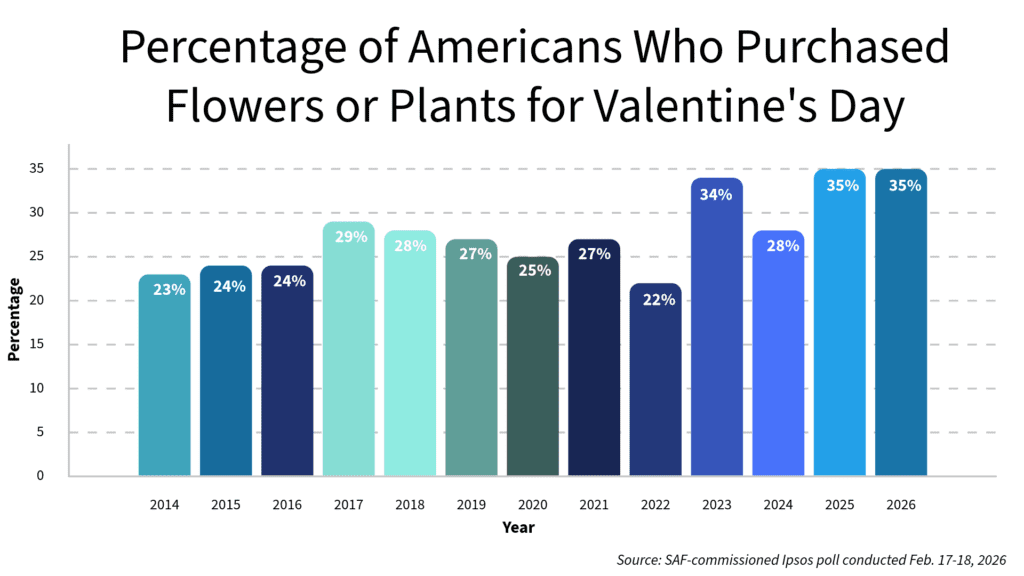
Americans’ appetite for flowers and plants held strong this Valentine’s Day, matching last year’s record-high buying levels, according to a new Ipsos survey commissioned by the Society of American Florists. Thirty-five percent of consumers purchased flowers or plants to celebrate the holiday, sustaining last year’s seven-point jump from 28% in 2024. The poll was conducted Feb 17-18 and surveyed 1,005 individuals.
Spending Goes Up
The number of buyers held steady, but their spending climbed over 2025.
- Most consumers (53%) spent more than $50, up seven points.
- Average spending reached a record $68.60, more than $7 higher.
- High-end purchases over $100 rose to 17%, up five points, while the portion spending more than $200 edged up a point to 4%.
- The most common price point was $21-$40 (19%), unchanged from last year.
Florists Gain Market Share
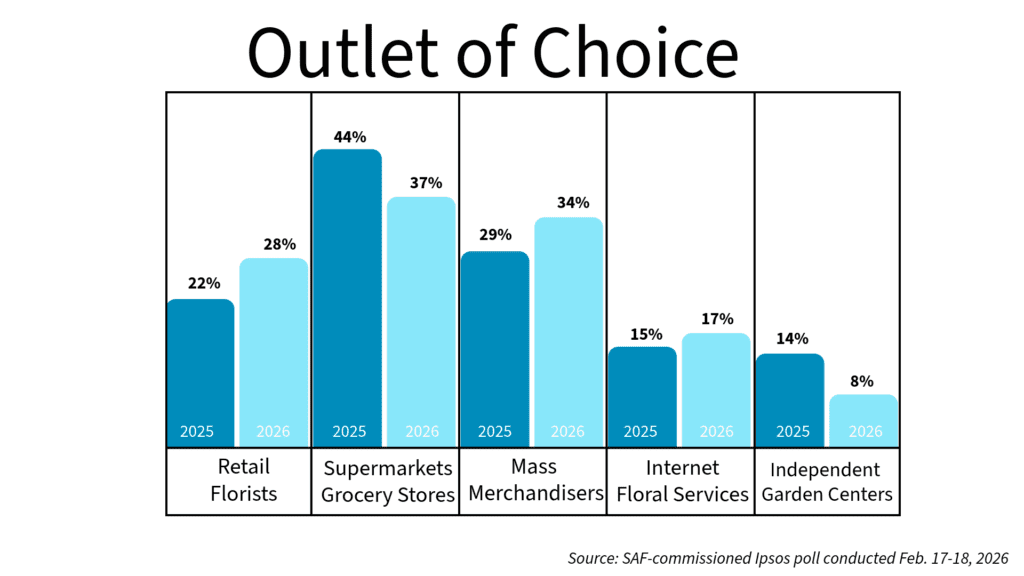
Florists gained six points, capturing 28% of consumers’ flower and plant purchases as the preferred buying destination.
- Supermarkets and grocery stores fell seven points from 2025 but remained the top source at 37%.
- Mass merchandisers and wholesale clubs rose five points to 34%.
- Internet floral services rose 3 points to 17%.
- Purchases from independent garden centers, greenhouses and nurseries declined to 8%, down six points from last year.
Gender and Age Shape Buying
Gender influenced buying decisions.
- Men made significantly more purchases from local florists (34%) — just one point behind their top choice, mass merchandisers – compared with 19% for women.
- Women made most of their purchases at supermarkets, 44% versus 31% for men.
Age also shaped shopping patterns.
- While mass merchandisers or supermarkets were the top choice for all age groups, younger buyers (18-34) were more likely to purchase from retail florists (36%), compared with 27% of those aged 35-54.
- Shoppers aged 55 and older were least likely to buy from florists, at just 12%.
Roses and Plant Purchases Rise
Roses continued to dominate the market.
- Roses made up 87% of purchases, matching 2024’s all time-high after a slight dip last year (83%).
- Red roses remained the top choice, bought by 75% of consumers – up six points from last year.
- Mixed colors of roses reached a new high of 35%, up five points.
- Plant sales rose four points to 28%.
- Single-flower bouquets excluding roses slipped to 39%, down three points from last year’s record 42%.
Future Purchases
Most consumers said they expect to buy flowers or plants in the next six months at about the same rate as before—59% for others and 54% for themselves. These figures represent increases of nine and seven points, respectively.
Fewer consumers expect to buy more for others than last year, down 10 points from an all-time high to 28%. Similarly, 22% said they plan to buy more for themselves, a seven-point drop.
The top three factors influencing those decisions were a need to connect (54%), convenience (46%), and finances (43%). Twenty-six percent cited reminders or store promotions, up six points, suggesting an opportunity for florists to boost sales.
Future purchases are most likely to be made at supermarkets or mass merchandisers, with the latter gaining ground. Future purchases from florists dipped two points to 21% when buying for others but rose five points to 19% when buying for themselves.
Men said retail florists will be their top source for future purchases for others (26%) and tied with mass merchandisers when buying for themselves (23%). Women showed a stronger preference for supermarkets — 30% when purchasing for others and 39% when buying for themselves.
Retailer Sales Mixed
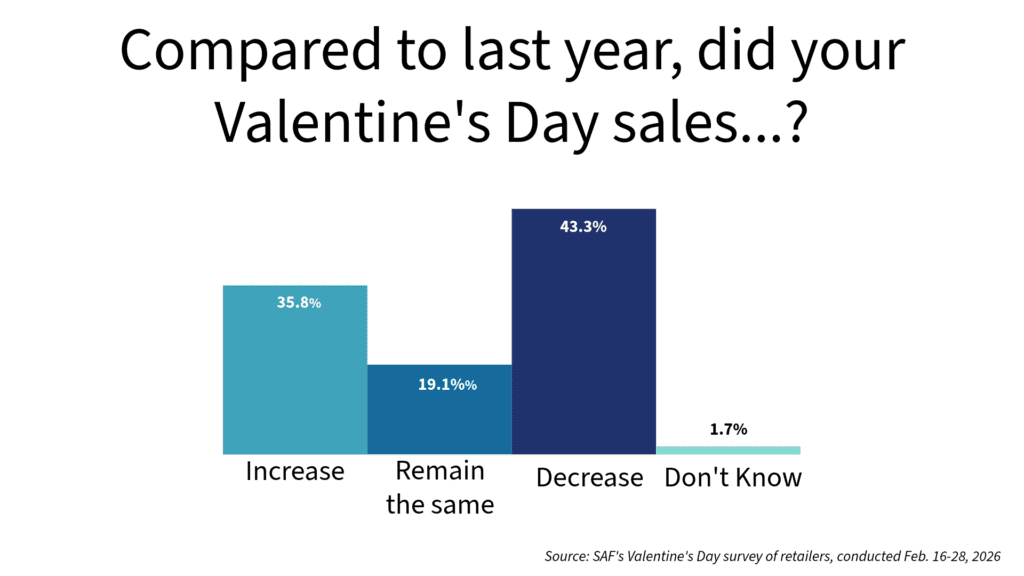
In a separate survey of 120 retailers, conducted in February by SAF, almost 36% reported an increase in sales from 2025, down 3% from last year’s survey. Forty-three percent reported a decrease in sales, with 19% reporting flat sales.
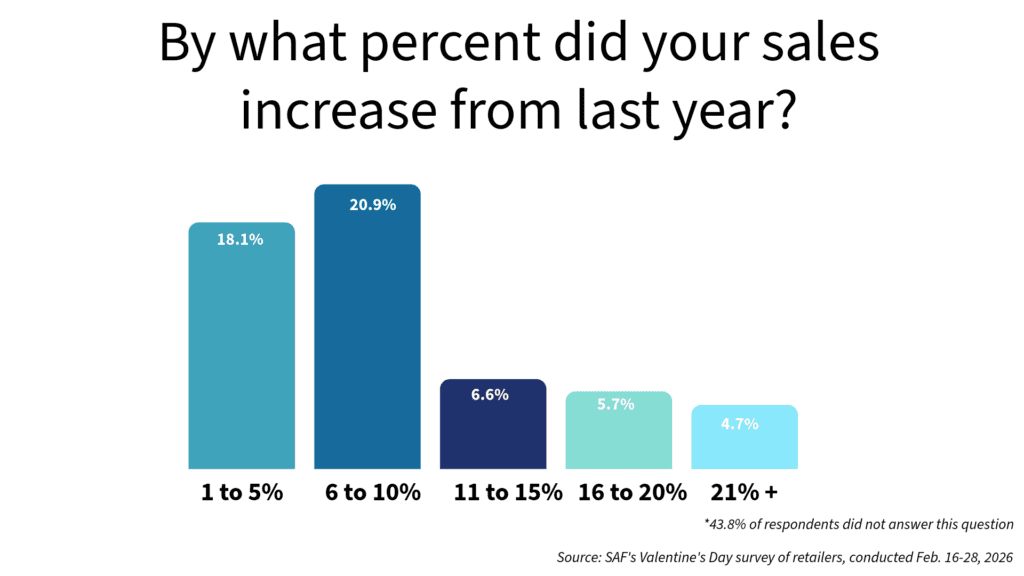
Of those with increases, almost 21% reported an increase of between 6% and 10%. Walk-in sales saw the most growth over last year with 65% reporting an increase in walk-in business.
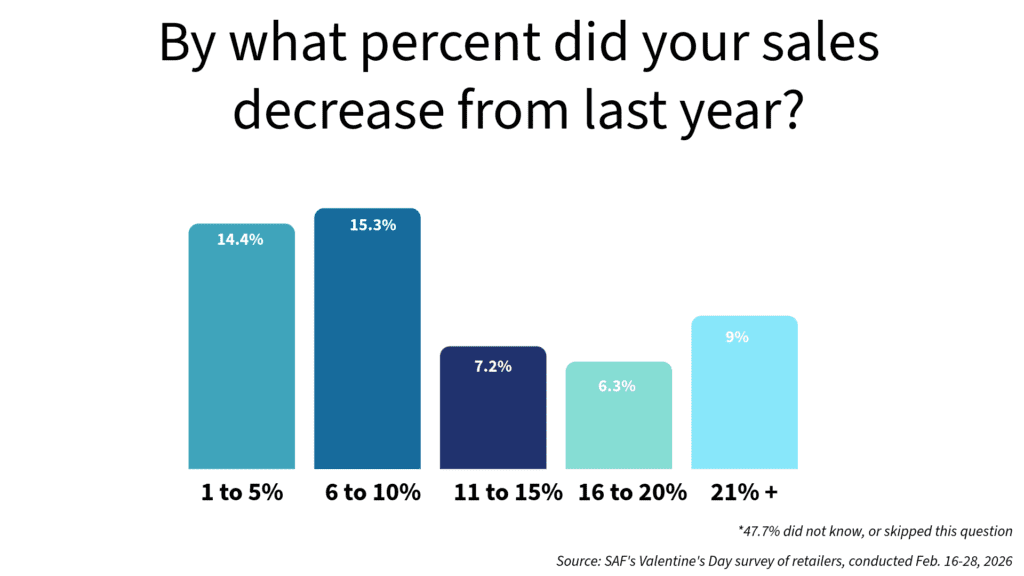
Of those with a decrease in sales, 15% reported a decrease between 6% and 10%. Phone sales dropped the most year over year, with nearly 50% reporting fewer orders, compared to about 35% last year.
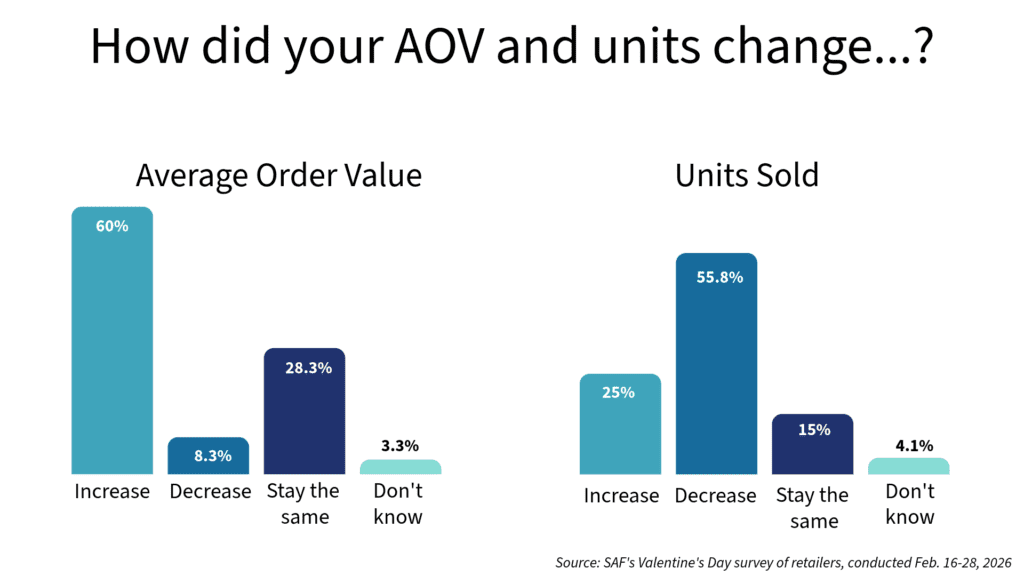
Value Up, Units Down
Average order values were up for 60% of respondents and remained the same for 28%, nearly identical to last year’s survey findings. Number of units sold were down for 55% of respondents.
Pre-orders High
Florists saw strong early demand for Valentine’s Day orders, with nearly 63% reporting that more than half of orders came in before the holiday. Most orders, however, were still delivered on Valentine’s Day.
Saturday Holiday Impact Varied
Valentine’s Day fell on a Saturday, with President’s Day following on Monday. Almost 66% of florists who reported decreased sales attributed it to the day of the week, some noting the three-day weekend may have led consumers to eschew flowers for mini vacations.
Among florists who saw increased Valentine’s Day sales, 28% said the day of the week provided the boost. Many reported stronger walk-in traffic, including Danielle Sattazahn of Holland’s Floral in Duncannon, Pennsylvania, who noted that it was the highest cash-and-carry Valentine’s Day she’s ever experienced.
The Saturday holiday posed a logistical challenge for some florists attempting deliveries. Respondents said tracking down recipients and/or scheduling drop-offs was difficult because couples were out celebrating. Carrie Moore, AAF, PFCI, of Petals & Pages in Custer, South Dakota, pre-emptively tackled the challenge. “I partnered with many restaurants to offer free delivery to the restaurant and to have flowers on their table before they got there,” she said.
Other florists reported the weekend holiday eased same-day delivery, spreading deliveries throughout the week. “It was wonderful to spread the work out over a few days so we didn’t have many late nights,” said Marisa Guerrero of Debbie’s Bloomers in El Paso, Texas. “We were surprised by how many deliveries were scheduled for Friday instead of Saturday so they could be enjoyed at work.”
Dalene Baker of Baker Florist in Dover, Ohio, used the Saturday holiday as a marketing opportunity to push early deliveries. “We promoted making Friday the 13th lucky by sending flowers early for Valentine’s,” she said.
Laurie Herrera is a contributing writer for the Society of American Florists.