

One of the nation’s largest lifestyle publishers changed the headline of a Mother’s Day article after outreach from the Society of American Florists over its negative comparisons to flowers.
The article, published by Apartment Therapy, was originally titled “This $15 Anthropologie Gift Might Be Better Than Flowers for Mother’s Day” and included language suggesting paper bouquets have fresh flowers “beat in almost every category” because they won’t “wilt within days.”
After outreach by SAF, the publication updated the headline to “This $15 Anthropologie Find is Our Go-To Gift for Mother’s Day.”
The exchange was the result of SAF’s ongoing efforts to push back against marketing that bashes flowers and encourage companies and media outlets to promote products on their own merits rather than positioning flowers as disposable or inferior gifts.
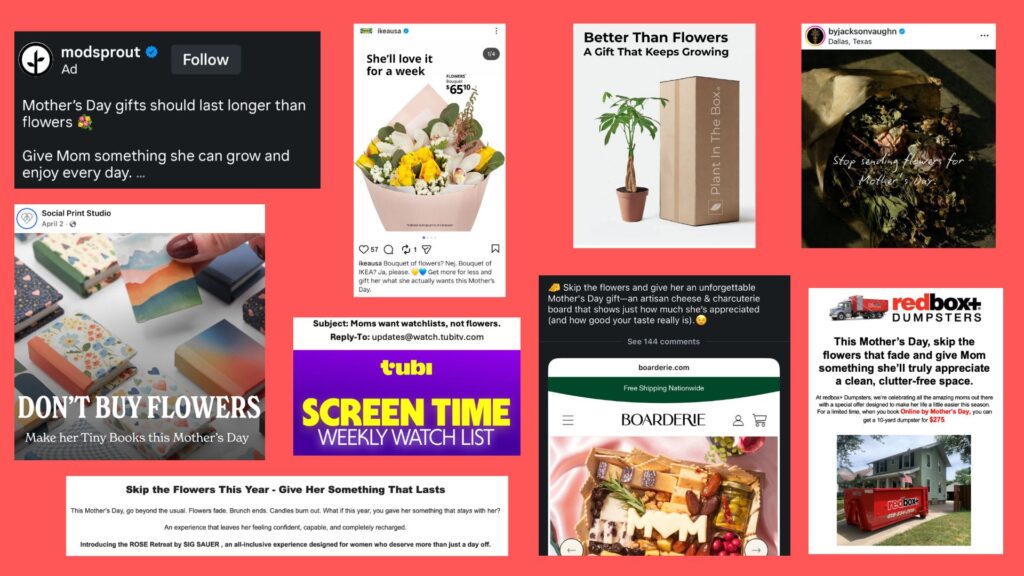
Over the past several weeks, SAF contacted the following companies regarding flower-bashing promotions and campaigns:
- Jackson Vaughn, a luxury fragrance company, posted an Instagram advertisement stating: “Stop sending flowers for Mother’s Day.”
- Social Print Studio, a photo printing and personalized gift company, promoted Mother’s Day gifts with the statement: “DON’T BUY FLOWERS. Make her Tiny Books this Mother’s Day.”
- Redbox+ Dumpsters, a dumpster rental and waste removal company, advertised: “This Mother’s Day, skip the flowers that fade and give Mom something she’ll truly appreciate.”
- Boarderie, a nationwide gourmet charcuterie and cheese board delivery company, ran social media advertising stating: “Skip the flowers and give her an unforgettable Mother’s Day gift.”
- IKEA USA, the international furniture and home goods retailer, ran a Mother’s Day Instagram campaign featuring phrases such as “She’ll love it for a week,” “Bouquet of flowers? Nej. Bouquet of IKEA? Ja, please” and “Get more for less and gift her what she actually wants this Mother’s Day.”
- SIG SAUER’s ROSE Retreat campaign, a women-focused firearms training and wellness retreat experience, used the headline: “Skip the Flowers This Year – Give Her Something That Lasts” and copy stating, “Flowers fade.”
- Easyplant, a self-watering houseplant and planter company and repeat offender, promoted plants using the phrase: “Forget flowers.”
- Modern Sprout, a company specializing in grow kits and indoor gardening gifts, advertised: “Mother’s Day gifts should last longer than flowers.”
- Plant In The Box, an online plant gift delivery company, used phrases including: “Better Than Flowers” and “Flowers die in days.”
- Space Art & Designs, a custom space-themed artwork and home décor company, featured the statement: “He didn’t give me flowers. He gave me the sun and moon.”
- Tubi, a free streaming television and movie platform, used the email subject line: “Moms want watchlists, not flowers.”
- The DRIPBaR Rye, a wellness and IV therapy spa, sent a text message promotion encouraging customers to “Skip the flowers this year.”
- Must Do Canada, a travel and lifestyle newsletter and content platform, distributed an email campaign with the subject line: “Skip the flowers this year” and copy such as “Skip the Flowers. Do This Instead” and “Flowers are lovely. For about three days.”
“There are many positive reasons for consumers to purchase wellness experiences, entertainment subscriptions, gifts, plants, or experiences without relying on unnecessary negative comparisons to flowers,” says Elizabeth Daly, SAF’s director of marketing and communications.
If you choose to respond to negative advertising, Daly recommends following these tips to write an effective message:
- Be objective, diplomatic, and reasonable. Explain that you believe products are most effectively promoted on their own merits.
- Avoid sounding defensive. A calm, professional tone is more likely to generate a constructive response.
- Don’t make unreasonable demands. Unless content contains factual inaccuracies, focus on education and advocacy rather than retraction requests.
- Suggest a more positive alternative approach. For example, instead of “Skip the flowers,” encourage messaging such as “Pair flowers with…” or “In addition to flowers…”
Amanda Jedlinksy is the senior director of content and communications for the Society of American Florists.